
Brushwork Tattoos
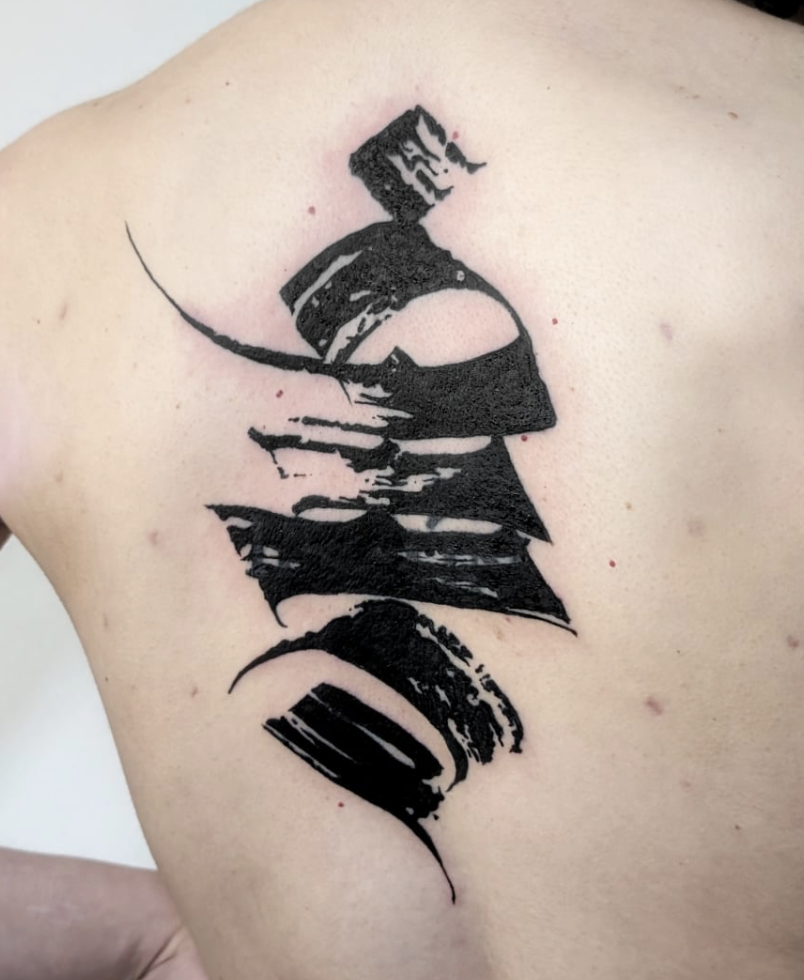
Brushwork tattoos — also called ink brush, brushstroke, or ink wash tattoos — are tattoos made to look as though they were painted with an ink-loaded brush rather than drawn with a needle.
What are brushwork Tattoos?
Brushwork tattoos — also called ink brush, brushstroke, or ink wash tattoos — are tattoos made to look as though they were painted with an ink-loaded brush rather than drawn with a needle. Instead of clean, even outlines, the image is built from strokes: broad sweeps that darken and then streak out as the brush "runs dry," splatters and flicked-off droplets, soft washed-grey edges where ink was diluted, and abrupt tapered ends.
The visual grammar comes from East Asian ink painting — sumi-e in Japan, shuǐ-mò in China — where a bamboo brush on paper or silk produces exactly this variation from saturated black to pale smoke in a single movement.
A good one looks spontaneous and gestural, with empty skin doing as much work as the ink, even though it's been planned and executed slowly. The subject can be anything — koi, dragons, snakes, mountains, bamboo, birds, a face half-dissolving into a stroke, an ensō circle, kanji, or an abstract swipe with no subject at all.
Why choose a brushwork tattoo?
People choose them mainly for the feeling of movement they carry.
A solid neo-traditional koi and a brushwork koi depict the same animal, but the brush version looks like it's still swimming, mid-turn, because the fading stroke reads as water and momentum.
There's also a philosophical draw that the other styles don't have: East Asian ink tradition prizes the single committed stroke, imperfection included, and the aesthetics of emptiness and transience — so the tattoo tends to carry ideas about flow, letting go, or the fact that nothing holds its shape, without needing a quote to say so.
Practically, they're flattering on the body in ways rigid designs aren't. Strokes can be laid along a muscle so a limb looks longer or more defined, the soft edges blend into skin with no hard border to age badly, and abstract brushwork is one of the few styles that works beautifully as a standalone piece rather than needing to depict something. They also age in a forgiving way — as any tattoo softens slightly over decades, a style whose whole language is softness loses nothing.
Which subjects work best in brushwork?
Traditional Japanese and Chinese ink painting is the source, so if you want the real thing rather than a stylised version, look for artists working in Iregumi-style Japanese tradition or dedicated sumi-e tattoo artists; dragons, koi, tigers, peonies, waves, pine branches and ensō circles all belong natively here.
Pure abstract brushstrokes or swashes — a single swipe, sometimes shaped into a mountain or a bird — are the minimalist end and suit small placements like the inner arm, spine or ribs. Ink wash or watercolour-brush hybrids add colour bleeding at the edges of a black design, which suits flowers, birds and cosmic or landscape subjects if you want some hue without going full colour.
— a word or name written as actual brush lettering rather than typed text inside a box — is its own sub-genre and only works with an artist who genuinely writes with a brush, since a badly simulated script reads instantly as fake. Realism and brushwork combine well too: a portrait or an animal rendered realistically that dissolves into strokes at one edge, which is a strong way to depict memory, decay or grief.
Things to consider:
Technique varies: one version is just a normal tattoo with fuzzy edges painted on digitally, while the other version reproduces a dry-brush texture, true gradation and splatter logic, you will be able to see in an artist's healed portfolio, not their line work.
The style depends on soft contrast, and all soft grey detail in a tattoo flattens somewhat over twenty or thirty years — a design built entirely from pale washes will fade faster than one with some genuinely dark strokes anchoring it, your artist is likely to recommend a few deep blacks in the composition for this reason.
You may also like…
-
![Your first tattoo]()
Your First Tattoo
Considering your first tattoo? Hear from those recently in the same position to help guide your decision or put any fears at ease.
-
![Constellation tattoo]()
My Tattoo Healing Experience
Learn from one of our valued customers on how they navigated an effective healing experience.
-
![Eagle tattoo]()
Tattoo Styles
Explore all the different types of tattoo to find the perfect style for you.


