
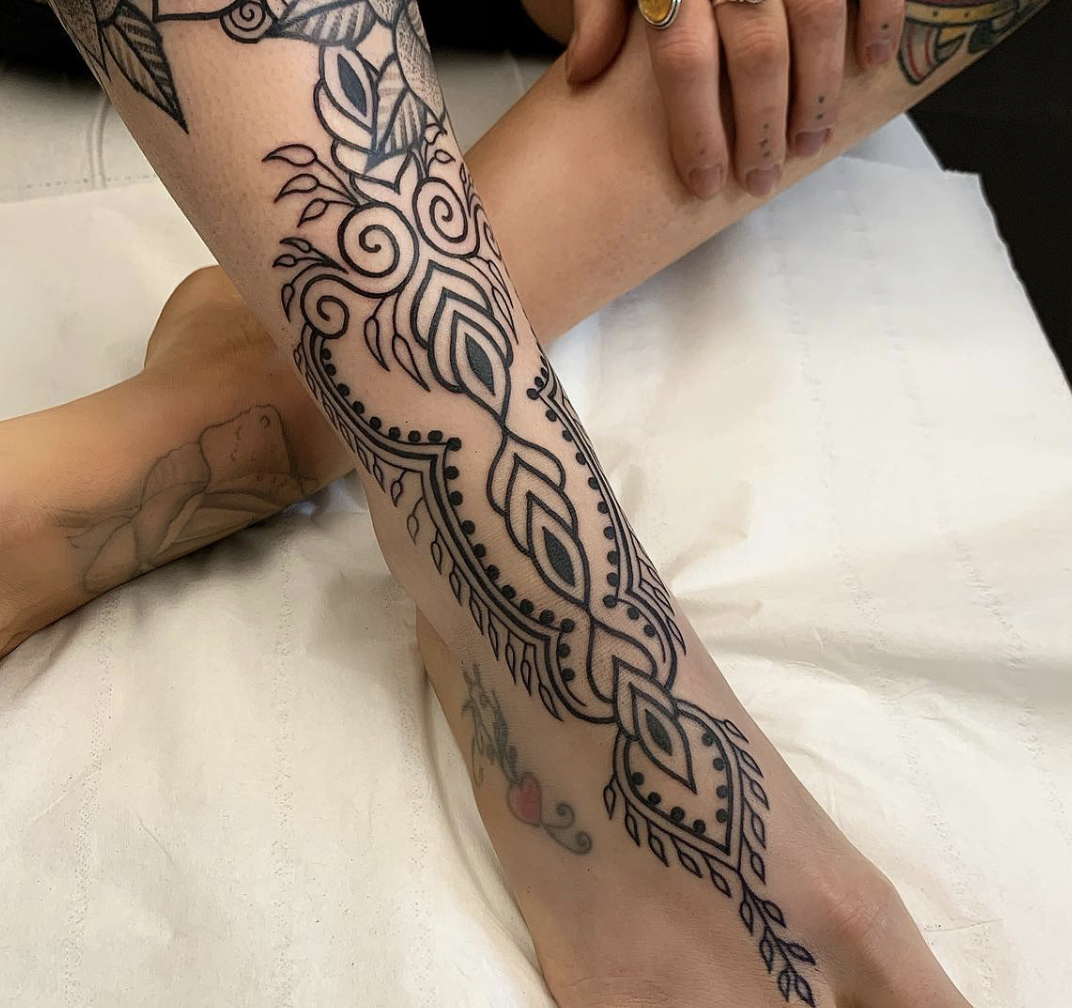
Sacred Eastern Tattoos
Sacred Eastern tattoos are tattoos rooted in the spiritual and cultural traditions of Asia, where ink has historically carried meaning far beyond decoration.
What are Sacred Eastern Tattoos?
Sacred Eastern tattoos are tattoos rooted in the spiritual and cultural traditions of Asia, where ink has historically carried meaning far beyond decoration. The best known come from three traditions: the Sak Yant of Thailand, Cambodia and Myanmar, where monks or ajarn masters bless hand-poked geometric and animal designs in Pali or Khmer script; Japanese irezumi, where dragons, koi, phoenixes and waves tell stories of perseverance and protection; and South Asian and tribal traditions such as India's hand-poked marks, Borneo's Iban motifs, and the tattoos of Taiwan's indigenous peoples, which mark ancestry, status and protection. In nearly all of them, the tattoo is understood as an amulet you carry on your skin, meant to bring luck, strength, or ward off harm, rather than a picture for its own sake.
Sacred Eastern tribal tattoos points to the communities that kept tattooing as a living ritual practice: headhunters' marks, lineage signs, spirit protection, rites of passage. What makes them "sacred" rather than merely traditional is that the tattoo is believed to do something in the spirit world, protecting the wearer from harm, guiding them to the afterlife, signaling status to ancestors, or completing a rite the person could not enter adulthood, marriage or war without.
Sacred Eastern Tribal Traditions:
The Kalinga of the Philippine Cordilleras, where the last mambabatok, Whang-od, has tattooed warriors and women with hand-tapped patterns of centipedes, rice terraces and python scales for over eighty years;
The Iban of Borneo, whose bungai terung (eggplant flower) shoulder mark began a man's journey toward the throat tattoo that marked a successful headhunter; the Mentawai of Siberut Island in Indonesia, whose tattoos made of spirals and leaf motifs are said to keep the soul inside the body and light the way after death;
The Ainu of Japan and Sakhalin, whose women received mouth and arm tattoos believed necessary for the afterlife; and the indigenous peoples of Taiwan, such as the Atayal and Paiwan, whose facial and body tattoos marked adulthood, weaving skill and noble lineage.
Further east, the traditions of Myanmar's Chin women (facial tattoos to mark clan and, by some accounts, to make them unattractive to kidnappers)
The hand-tapped work of Vietnam's and India's Apatani and Rabari peoples belong to the same family.
The common thread across all of them is that the pattern belongs to the community, not to the individual getting it.
A Kalinga centipede, an Iban flower, or a Mentawai spiral is a language: it tells other members of the group who you are, what you've done, and what protections you carry.
That's why the question of getting one as an outsider is delicate. Some communities now share their art with respectful outsiders (Whang-od has trained apprentices and receives visitors; some Iban and Mentawai practitioners tattoo tourists), while others consider the designs closed.
The difference between a sacred tribal tattoo and a "tribal-style" one you'd find at a regular studio is exactly this: the studio piece borrows the look, while the real thing only exists within the permission, ritual and meaning of the community that made it.
If the tradition itself draws you, the respectful path is the same in every case: learn which communities share their work, go to the source, and let them decide what an outsider may wear.
Popular types of Scared Eastern Tattoos:
In the Sak Yant world, the most requested designs are the Hah Taew (five lines, for luck, protection and charisma), the Gao Yord (nine peaks, general protection), the Paed Tidt (eight directions, safe travel), the twin tigers Suea Koo for courage, and the Hanuman monkey god for strength and cleverness.
In Japanese tradition, the koi swimming upstream (perseverance), dragons (wisdom and power), phoenixes (rebirth), Hannya masks and peonies are the staples, usually composed as a full sleeve or bodysuit rather than a small piece. Tribal traditions such as those of the Kalinga of the Philippines or the Mentawai of Indonesia use geometric patterns tied to family lineage, milestones and nature, and Polynesian-influenced pe'a and tā moko, though Polynesian rather than Eastern, often get grouped in this space too.
Beyond hand-tapping, the other styles people seek out are these.
Borneo tribal work, from the Iban and other Dayak peoples, is built from the bungai terung (the eggplant-flower shoulder mark that starts a person's journey), the scorpion, the crocodile and the boglike spiral-and-vine patterns that cover arms and legs; it's arguably the most imitated "tribal" style in the world, which is worth knowing, because the copies and the tradition are very different things.
Mentawai tattooing from Siberut, Indonesia favors spirals, leaf shoots and river motifs in dense symmetrical bands over the chest, arms and legs, each one explained as keeping the soul in the body. Ainu tattooing, traditionally on women's mouths and hands, uses fine chevrons and spirals tied to fire and to the afterlife.
Chin women's facial tattoos from Myanmar and the facial and body marks of Taiwan's Atayal and Paiwan are among the rarest and most protected, closely tied to clan identity and largely not shared with outsiders.
In terms of what's actually popular with people getting them today, three things dominate: Sak Yant designs like the Gao Yord and twin tigers, usually on the shoulder, upper back or chest; Borneo and Dayak-inspired arm and shoulder pieces, often adapted as half or full sleeves; and Kalinga batok patterns on the upper arms, shoulders and shoulder blades, frequently sought as a travel ritual in Buscalan itself.
There's also a large second tier of "tribal-inspired" blackwork, bold geometric bands, spears and motifs derived from these traditions but designed by the tattooist, which is the most common thing people actually mean when they say they want a tribal tattoo.
If you're choosing among them, the practical differences are real. Hand-tapped work takes longer, hurts somewhat differently (many say a duller, more grinding pain than a machine), and typically requires going to the tradition's home or a practitioner trained there. Machine-worked tribal designs are faster and easier to get anywhere but carry less of the ritual weight. Placement follows tradition in most of these cultures: shoulders, upper back, chest and arms, with facial and hand tattoos generally reserved inside the communities themselves. The one rule that keeps you on the right side of all of it: get the style from within its tradition where you can, learn the meaning of your specific pattern before you wear it, and treat a closed design, like Chin facial tattoos or Ainu mouth tattoos, as exactly that.
Best placement for Scared Eastern Tattoos:
Tradition matters here more than fashion.
Sak Yant is typically placed over the shoulders and upper back, or on the chest: close to the heart and head, where protection is believed to radiate outward. Many practitioners consider the head, face and feet inappropriate, and a traditional master will advise placement, not the other way around.
Japanese irezumi usually builds from a back piece, sleeve or hip panel, areas that can be covered by clothing, which is historically significant in Japan itself. Practically speaking, shoulders, upper back, chest and thighs hold fine-line and geometric work well and age better than hands, feet or inner wrists.
Why get a Sacred Eastern Tattoo?
People choose them for reasons that range from spiritual to aesthetic.
A real blessing (the traditional sak yant ends with the master blowing the yantra or chanting over it) gives some people a lasting sense of commitment or protection, a permanent reminder of a value like courage, resilience or compassion.
There's also the craft itself: hand-poked bamboo work and large-scale irezumi are among the most demanding tattoo traditions on earth, and wearing one connects you to centuries of living art.
An honest word of caution: these are sacred to the cultures that made them. If you get one, go to an Artist who understands the meaning, culture and works within the tradition (a respected ajarn in Thailand, an irezumi-trained artist, a tribal practitioner), learn what your design actually means, the cultural connection and weight associated with the design means you are representing it with respect rather than just choosing it based on aesthetics alone.
The first is meaning that outlasts the moment. Most tattoos start as a picture you liked, but sacred Eastern tribal traditions were built for something different: the mark records something true about you, courage, survival, a threshold crossed, protection you're asking to carry, and it's meant to still be saying that when you're eighty. People who get a Gao Yord or a batok pattern often describe it as less "choosing a design" and more making a commitment, the way a vow does. If you've been through something that changed you, or you're entering a new chapter of life, that's the traditional reason these tattoos exist at all.
The second is the ritual itself. There's a real difference between sitting in a studio with a machine and being tattooed by hand, in the tradition's own setting, by someone trained in it, sometimes with a blessing spoken over the finished work. Hand-tapping in Buscalan or a sak yant blessing from an ajarn is an experience people remember for the rest of their lives precisely because it isn't transactional. You're not buying a picture; you're receiving a mark through a process that has been done the same way for generations.
The third is connection and craft. These traditions survived colonisation, war and modernization to reach us, and wearing one, done respectfully, is a way of honoring the communities and master practitioners who kept them alive. The hand-tapped texture itself is also genuinely beautiful in a way machine work rarely matches: organic, imperfect, human.
And the fourth, frankly, is aesthetic, and there's nothing wrong with that being part of it. Bold blackwork, geometric symmetry and patterns designed to sit with the muscle of the shoulder or arm look striking in a way few other styles do.
The honest counterweight: these marks belong to living communities, so the "why" matters as much as the "what." Getting one because you understand what your specific pattern means, and where it may sit on the body, is very different from picking a design off a flash sheet. If your reason is purely visual, a tribal-inspired piece designed by a good artist is the more honest choice. If your reason is meaning, ritual, or respect, then going to the source is the whole point, and the tradition will usually meet you there. Which of those pulls you most is the real question, and it's the one that should decide where you go and what you wear.
You may also like…
-
![Your first tattoo]()
Your First Tattoo
Considering your first tattoo? Hear from those recently in the same position to help guide your decision or put any fears at ease.
-
![Constellation tattoo]()
My Tattoo Healing Experience
Learn from one of our valued customers on how they navigated an effective healing experience.
-
![Eagle tattoo]()
Tattoo Styles
Explore all the different types of tattoo to find the perfect style for you.


